1- What is Sexuality?
It’s not easy to define sexuality.
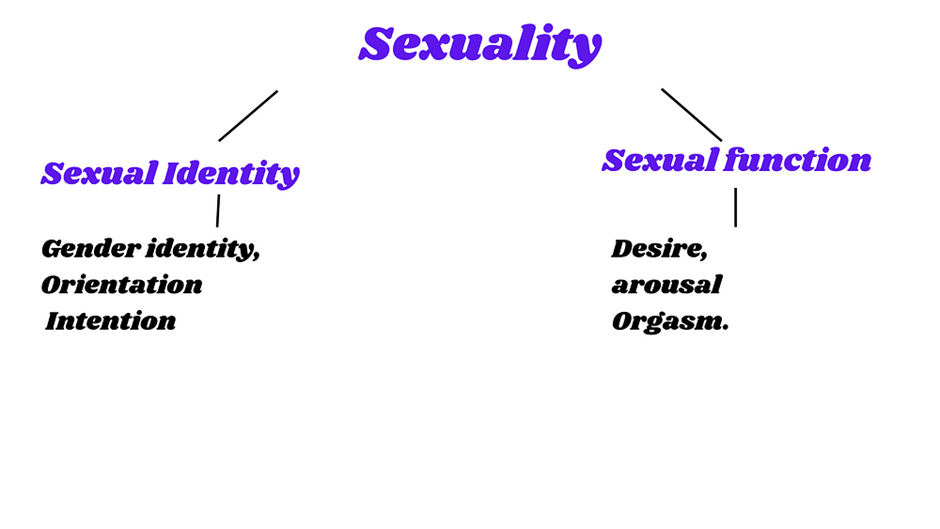
Sexuality mainly has two components.
1- Sexual Identity
2- Sexual function
1- Sexual identity constitutes –
Gender identity, Orientation, and intention
While as sexual function ensembles
Desire, arousal, and orgasm.
All these combine to give sexual and emotional satisfaction.
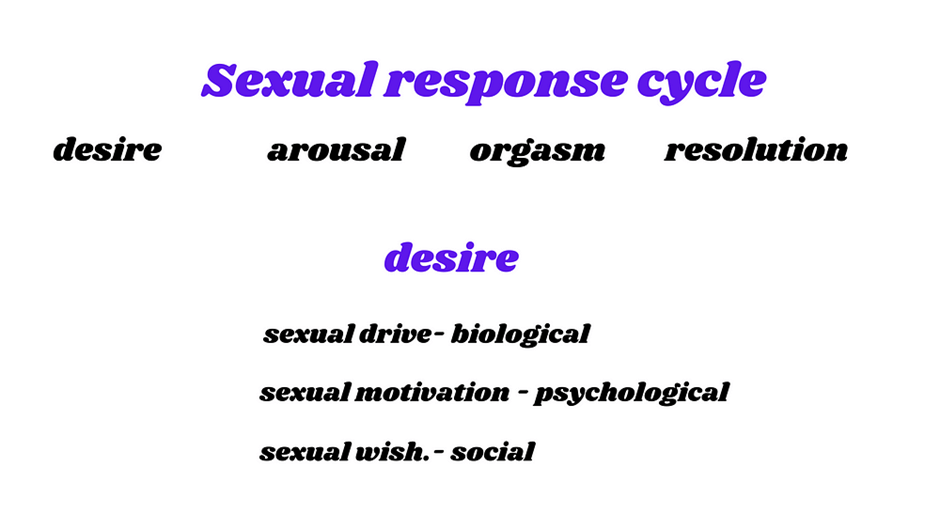
The sexual response cycle consists of 4 stages-
desire, arousal, orgasm, and resolution.
Desire- consists of
sexual drive– biological
sexual motivation — psychological
sexual wish- social
Sexual drive is controlled by the Limbic system, the preoptic area of the hypothalamus.
Certain hormones and dopamine increase the sex drive. Certain medications like antihypertensives can decrease the sex drive.
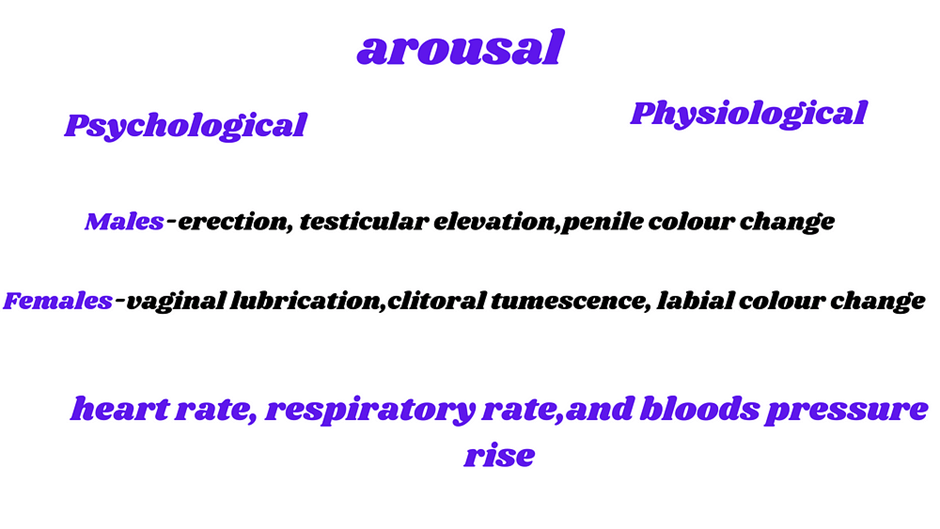
Sexual arousal is of two types.
Psychological
Physiological
Arousal leads to :
In males– erection, testicular elevation, penile color change
In females– vaginal lubrication, clitoral tumescence, and labial color change.
In arousal- heart rate, respiratory rate, and blood pressure rise.
Orgasm- is vasocongestion. BP, heart rate, and respiratory rate remain elevated.
Resolution- After orgasm- heart rate, BP, and respiratory become normal.
If a sexual act doesn’t end in orgasm, the congestion is not relieved, which leads to irritability and discomfort that may last for several hours.
If the act ends in orgasm, they experience calm and relaxation.
Any problem during the sexual response cycle may lead to dissatisfaction.
Sexual counseling can solve the problems.
2-Why is Premarital Counseling Required?
There is a crying need for ‘premarital counseling’ today for a simple reason, that it is not taught in any of the schools; not even in the Medical schools.
We always prepare ourselves well in advance for a short journey on vacation.
Marriage is a long journey. How many times do we prepare ourselves for this long journey?
Marriages are not made in heaven, as is commonly believed!
Marriage is not about falling in love; it’s about walking together in love. Being ready for marriage is a sign of maturity. If you are not yet ready for it, defer it till you know you are ready for it.
We generally concentrate on not-so-relevant aspects like looks, physical smartness, money background, and religion. Indians even consult a Brahmin to get the auspicious date and time so that nothing should go wrong in the future.
Adjustments are a part of life. But then the real-life problems are camouflaged under the influence of hormonal upsurge. This is an age when the hormones hijack our cognitive abilities.
Counseling is an effective way of improving your communication and conflict management skills.
Generally, marriages are instinctive decisions. Ideally, they should be the most thought-after ones.
We should focus rather on the following points –
1) The foremost important thing is to decide if it’s a long or a short journey!
If it’s a short journey then it’s a case of lust. Don’t even think of marriage.
2) Family background
It’s important. An academic person will be a misfit in a political or business family. A criminal family background will, most probably, not offer you a long-lasting and satisfactory relationship.
3) The role of an individual
Establishing a boundary and the role of an individual is important. Or else even — who will do the dishes — might become a starting point of a conflict.
If both are doing jobs, then it becomes doubly difficult. There should be a clear-cut distribution of tasks.
4) Compatibility
Academic, cultural, and economic disparities should be considered. Different religious beliefs could become a contentious issue.
5) Communications and conflict resolution
Disagreements are a part of our married life. We cannot generally change people! We can only influence them. The basic pattern remains the same. How to process the differences? Forgiving and apologizing are not the signs of weakness. We should learn to say sorry to put everything on track again.
Maintaining proper communication is the essence of a relationship. Ask yourself if you can have a friendly conversation with your partner at the dinner table, every day. Any conflict or disagreement can be solved with proper communication.
Remember, all the problems do not find their solutions in a bedroom.
5) Mutual expectations
What are your expectations from your partner? There has to be a common meeting ground.
6) Career
If both are working then career has to be discussed. There are adjustments and compromises. Someone has to walk a step back.
7) Raising a family
Planning a pregnancy is a very important step. It requires not only consensus but also readiness on adjusting several issues.
Both the parties should be given a fair idea about the birth control measures in the initial period of their sexual lives.
8) Money matters
Discussing the financial situation is another area that requires discussion.
9) Sexual expectations
It’s better to discuss them before you tie a knot.
These are a few points you should ponder about before taking the most important decision of your life.
Once you decide to marry, you need to go in for premarital sexual counseling.
3- How Does Premarital Counseling Work?
Once you decide to marry, you need to discuss, among all things- your sexual goals and sexual expectations.
Sex is not only an essential but the most beautiful part of an alliance. And hence when you start this journey, you should leave behind the wrong and preconceived ideas about sex.
It’s nowhere near whatever is portrayed in most Hollywood flicks. And it’s far away from the way it’s depicted in porno movies.
Sex is an experience that involves gratification for both partners.
What are the facts, common problems encountered, and the solution?
Here are some of the myths and facts-
1-Sex is not only about penile penetration, although it’s an essential part of the process.
2-Lasting longer does not guarantee contented sex. The world average for actual penile penetration is not more than five minutes. The scenario you see in porno movies- the man, lasting for hours- does not exist.
A man lasting for more than the average time might leave a woman high and dry.
And the one lasting for a minute could leave a woman fully satisfied if he knows the nuances of sex.
3- The long penis does not guarantee more satisfactory sex. The average vaginal length is 3 to 6 inches. And the most sensitive part of vaginal anatomy- the clitoris- is hardly deep. A very long penis is a discomfort for a woman.
4- Man has the disadvantage of having a refractory period in two orgasms that could last for 30 minutes to several hours. Meaning thereby after reaching climax, he has to wait for another erection. He is incapable of penetration during this period. While, a woman is capable of getting multiple serial orgasms without any waiting period.
5- More often than not, the penis fails to rub the clitoris because, in every woman the position of the clitoris varies. In this scenario lasting any length of time is not going to help.
6- The penis and clitoris are not the only erogenous zones. It could be breasts, nipples, inner thighs, lips, or ear lobules. Try to identify this zone in your partner.
7- Foreplay and after-play are the two most important stages of sexual experience.
Having understood this much of the basics, we can now move further, step by step.
1) The first night after the marriage is always heavily touted as the most important night. In India, it has a celebratory value. In the western world, things are different.
Penile intercourse- should be avoided on this night. Both the partners should spend this privacy on understanding each other.
The couple should speak to each other, try and develop a bond, fondle each other, and know the erroneous zones.
Once you go past this phase, then you can indulge in foreplay.
A man can ask his partner to lead his finger to her clitoris. A gentle rubbing for one minute can give her a full-blown orgasm.
Similarly, a woman can masturbate her man to orgasm.
By not resorting to intercourse on the first night, you are helping yourselves on two counts.
a) You are taking away the shin of an extra high sensitivity that might abort your first attempt at sex.
b) Man will not end up- getting premature ejaculation leaving the woman completely unsatisfied.
I have encountered many patients whose genesis of premature ejaculation (PME) lay in that first night. That one failure haunts them every time they try to have sex.
2) Wear a condom. That might take away a little fizz but won’t make the things messy, and it takes away a little bit of sensitivity.
3) Two common complaints we come across are-
a) Situational erectile dysfunction- Where a man gets an erection with one partner:; while miserably fails with another.
b) premature ejaculation.
For both conditions, the most common cause is over-excitability.
Sexual counseling works magic if both the partners are willing and cooperative.
Your counselor can make things easier for you.
4- How Sex Gets Affected in Paraplegics
Spinal cord injuries (SCI) are serious. Damage depends on the level and extent of the injury.
Can a SCI victim have a normal sex life?
Well, may not be normal, but they can still enjoy sex.
One needs to understand the arousal system to get to the depth of it.
Arousal is of two types-
1- Psychogenic
2- Reflexogenic.
1-In Psychogenic arousal, message travels from the brain to the nerves in the genital area via spinal cord. The T11–L2 ( T- Thoracic, L- Lumber) level is responsible for the psychogenic pathway.
Hence people injured above the level of the T11 do not generally experience psychogenic erection or vaginal lubrication; but those with an injury below T12 can.
The psychogenic pathway is sympathetic. It also sends inhibitory signals that prevent the physical arousal response. In response to sexual stimulation, excitatory signals are increased and inhibition is reduced.
2-The Reflexogenic pathway activates the parasympathetic nervous system in response to the sensation of touch.
It is controlled by a reflex arc that goes to the spinal cord and is served by the sacral segments of the spinal cord at S2–S3.
A woman with a spinal cord lesion above T11 may not be able to experience psychogenic vaginal lubrication, but may still have reflex lubrication if her sacral segments are not injured.
Likewise, although a man may not get a psychogenic erection when mentally aroused, but he may still be able to get a reflex or “spontaneous” erection.
These erections may result in the absence of psychological arousal when the penis is touched even by clothing, but they do not last long and are generally lost when the stimulus is removed.
Reflex erections may increase in frequency after SCI, due to the loss of inhibitory input from the brain that would otherwise suppresses the response in an uninjured man.
Conversely, an injury below the S1 level impairs reflex erections but not psychogenic erections.
Like other reflexes, reflexive sexual responses may be lost immediately after injury but recover over the period of time.
Tertiary sexual dysfunction results from psychological and social factors.
Loss of bladder or bowel control adds to the misery. Reduced libido, desire, or experience of arousal could be due to psychological or situational factors such as depression, anxiety, and changes in relationships.
Both sexes experience reduced sexual desire after SCI.
With proper guidance the paraplegics can get some of their sexual life back.
5- What is the Need for Sexual Education
Youths are not receiving the sex education they need and deserve.
There exists a gulf between what they require and what they get!
Sex education should help people acquire the information and skills they need to make the decisions for themselves about sex and relationships. It is about learning the emotional, physical, and social aspects of sexuality.
What is sex education?
Learning the basics of the following parameters-
1-Puberty
Puberty is the process of physical changes through which a child matures into an adult capable of sexual reproduction. Puberty brings out dramatic physical and mental changes in an unprepared child. The girls and boys should be aware of all the changes in their bodies.
2-Anatomy
Both the sexes should be taught about their sex organs. Boys should know about the anatomy of the genitalia of girls and vice versa.
3-Menstruation
Some girls experience menstruation at the age of nine. The parents need to understand that their child experiences sexual development as she grows up. One big talk will not help the daughter gather knowledge and awareness about sexual activity.
Girls should be taught about their menstrual cycles well in advance to make them ready for it in the future.
4-Contraceptives
They should have a fair idea about condoms, contraceptive pills- pros and cons, avoidance of unwanted pregnancy, and abortion.
5-Sexual orientation
To identify the genders to which they are sexually attracted. E.g. heterosexual, homosexual, etc
6-Gender identity and body image
Understanding the differences and similarities between the genders will help them know more about their body and how it changes as they grow up. This mindset will set up a foundation for future development in acquaintance with their friends or lovers.
7-Relationships
Why one should know the intricacies of relationships between
families, friends, acquaintances, and lovers?
8-Personal skills
Why communication skills- to make life better?
How does one set the boundaries?
How to negotiate?
How to make the decisions?
9-Sexual behavior
What is Sexual or gender-based harassment?
It includes — offensive or humiliating behavior. The conduct of a sexual nature creates an intimidating, unwelcome, hostile, or offensive work environment.
10-Sexual health
Sexually transmitted infections, HIV, birth control, pregnancy, and abortion
Sex education gives the young generation the information and skills needed for good sexual health.
They can learn how to have healthy relationships, make informed decisions about sex, think critically about the world, and love themselves for who and what they are.
Need for sex education and reasons to support sex education in schools
Sex education should be mandatory in school.
Sex education does not promote sex but does the opposite.
Here are some reasons to support sex education in school:
1-Teenagers need to know safer options
2- Sexually educated students are more likely to say no to unprotected sex.
3- Through sex education, you can teach teenagers the pros and cons of sex.
They can learn about sexually transmitted diseases, teenage and unintended pregnancy, and the emotional effects of sex.
It teaches the students how to reduce the risk by using various methods such as condoms, the pill, and hormonal contraceptives.
Teens are alarmed about these things and engage in responsible sexual behavior.
Sex education teaches the child the basics of puberty, body changes, development, and a comprehensive understanding of their bodies and how to say no to unwanted sexual activities.
Often children who are unaware of their developments find it annoying to feel changes in the body. Sex education prepares the child emotionally for the changes a human body goes through.
The objective of sex education is to help children understand the body of men and women and to improve their attitudes towards sexual and reproductive health behaviors.
It is about self-acceptance and embracing your own body.
Good sex education teaches the young generation what constitutes sexual trauma. Sometimes kids are unaware of the sexual exploitation they are experiencing. They hesitate to tell their parents about it because of ignorance. Sexual violence is wrong, and kids have the right to know about their bodies and ask for help if they get assaulted.
Parents need to educate their children about sex
Pornography has become the mainstay of sex education for teens. Children are curious. They gather information about sex before the parents can even imagine. Therefore, parents should take the initiative to teach their children.
Parents need to ensure that they provide correct information to their kids.
Parents keeping silent about sex education can be detrimental as the child will eventually learn about it from its peers and over the internet.
Pros of sex education of boys and girls together
*Having an open conversation with boys and girls can eliminate the stigma associated with sex.
*Boys and girls get to learn about their mutual experiences.
*They learn to communicate on sensitive topics and know a lot about each other that will help if and when they want to develop intimate relationships in the future.
*Teaching them together creates a comfortable space between the genders.
*Boys and girls can learn from different perspectives when discussed in the class together.
Cons of sex education of boys and girls together
*Parents may feel uncomfortable letting their daughters receive sex education with boys present.
*It is difficult for the experts to differentiate the instruction to meet the unique needs of boys and girls when taught together.
*There might be hesitancy in asking questions about menstruation or nocturnal emission.
*The school authorities need to answer the concerns expressed by parents.
Sex education should be compulsory in every school. Comprehensive sex education is mandatory for young people to prepare themselves for any bodily changes and maintain their healthy and hygienic well-being.
The parents should realize that sex education does not promote sexual activity.
It offers them an opportunity to cultivate an understanding of the human relationship.
6- Erectile Dysfunction-Part 1
What was going on in the mind of the creator when he was gifting a man his sex organ?
Was it only for procreation?
Was it also meant to be for fun?
In some animals, the ejaculatory time is even less than 10 seconds.
Imagine you are passing through a jungle and see a lion. The lion notices you, but he also sees a lioness that appears to be in a wild mood. The lion would not give any thought to who he would prefer.
Before you could blink twice, he’d run for the lioness, deposit his sperms in the receptacle, and then rush toward you to devour his delectable food.
But this example is not enough to give you an idea that sex is only for procreation; because a lioness generally has sex, almost twenty times a day with different partners.
Now, that should tell you that sex is not meant only for procreation!
Erectile dysfunction(ED) has its space in clinical medicine.
ED can be defined as the inability of the man to attain and then sustain the penile erection sufficient enough to achieve satisfactory sexual intercourse.
A workable definition for a treating physician to decide whether a person qualifies for a working diagnosis is-“persistent inability for at least 3 months to attain or maintain an erection sufficient for satisfactory performance”.
In humans, procreation is a coincidence, if not an accident. The main purpose is recreation.
There is no way to know the prevalence of erectile dysfunction, for it still being a social stigma; people are not vocal with symptom. In my private practice, I see 2 to 3 cases every day. So if I see10 male patients per day the incidence should be at least 30% in the general population.
Talking about erectile dysfunction is still a taboo in India.
Incidentally, even those three patients who come to a clinic generally present themselves with some different problem. They just mention ED as a passing reference in a course of medical examination and try to portray it as just another symptom, though that’s a leading concern on their minds.
ED is very common in either the young population or those who are more than 60 years of age. Age-related erectile dysfunction is easier to explain. By the time men reach that stage most of them have diabetes, hypertension, metabolic syndrome, or some form of debilitating disease, which gives them a platform for ED.
The most common reason for teenagers is the pornographic material that is available on digital media, at the click of a button. In most of these instances, the sex is depicted in the most exotic possible way. So the teenagers grow up with weird ideas about sex. And when they get to experience their first encounter with sex, they learn it a hard way, that it is nowhere close to whatever is projected on the tube.
And then- what’s the natural outcome?
Abysmal failure!
This failure haunts them in the future whenever they have their sexual encounters. This forms a chain of failures from which it becomes difficult to emerge victoriously.
• Longer the better!
• Sturdier, the better!
• Longer lasting, the better!
These are the ideas they grow up with. Ironically this is the race where no man wants to come first. A man, who always tries his hardest to touch the finishing line first, wants to do the exact opposite when it comes to sex. But his brain is not conditioned for the situation.
And then performance anxiety takes over.
This is psychogenic erectile dysfunction.
The causes for psychogenic ED are —
• Relationship conflicts
• Sexual inhibitions
• Sexual abuse as a child
• Sexual preference conflicts
• Fear of pregnancy
• Fear of Sexually transmitted diseases
There is an intriguing story about what must have been going on in the mind of the creator when he made the penis.
First, he wanted to make it only for the sake of procreation. He changed his mind later. Why not create a level playing field where Adam can have a little fun!
He thought of several options.
First, he considered making a bony penis, but then that would constantly be in an erectile phase.
No way!
Men would have to move in three-legged trousers. There would be no way a woman could find out whether the man was excited after seeing her.
The second choice was to make it out of skeletal muscles. But the skeletal muscles would again require the help of bone for a support.
The skeletal muscles mean voluntary control. Men would move around the streets, flashing their erect organs all the time.
The creator must have thought it a vulgar concept!
No wonder; the idea was dropped!
Then he came out with this gem of a creation! There was no way this could have been any better. He created a special tissue called corpus spongiosum and corpus cavernosum. Once a man gets excited, blood enters in corpus spongiosum and corpus cavernosum, increasing both the length and the width of a penis. The function of the corpus spongiosum is to prevent compression of the urethra during erection.
Here is something interesting-
During physical activity, the blood supply to the heart increases 5 times its normal blood supply, but during sexual stimulation, the blood supply to the penis gets increased to phenomenal 100 times its normal!
What an idea!
Penis has autonomous control. No one can erect the penis at any given time at his will.
The other type of ED is “organic”, where you can pinpoint the cause of ED.
The list is long.
There were times when even experts would say that psychogenic causes account for 70% of all the causes of ED.
Now the opinion is exactly the opposite.
The causes of organic erectile dysfunction are-
1-Vascular causes are- Pre-existing cardiovascular disease, atherosclerosis, hyperlipidemia, hypertension, diabetes, and smoking.
One very important point to remember is- erectile dysfunction at a younger age could be a starting point for your cardiovascular event in the future. If atherosclerosis can start in penile arteries it can always start in your coronaries.
Diabetes Mellitus (DM) by far remains the most important organic cause of ED. Never forget the fact that DM is a disease of nerves and blood vessels
2- Anatomical- Penile fibrosis, Peyronie’s disease, Micropenis
3-Hormonal- Central hypogonadism, Thyroid disease, Cushing’s syndrome, Hyperprolactinemia, Metabolic syndrome, Obesity
4-Neurological- (Central)- traumatic brain injury, Parkinson’s, Multiple sclerosis (MS), brain tumors, spinal cord injury
5-Neurological-(Peripheral) — peripheral neuropathy, alcoholism,
6-Drugs- Beta-blockers, LHRH analogs (Luteinizing Hormone-Releasing Factors Agonists), antidepressants, recreational drugs (MDMA, LSD, oxycodone, amphetamine)
Psychological factors usually co-exist with organic ones. Even a bare minimal organic derangement causes performance anxiety.
What a physician needs to know is the answers to three basic questions-
1-Whether the disorder is of sufficient duration to warrant intervention?
2-Whether ED is the primary complaint or associated with other sexual dysfunction like PME (premature ejaculation) or low desire
3- Is the problem secondary to medication use, hormonal imbalance, a neurovascular disorder like DM, hypertension, metabolic syndrome, obesity, or psychogenic?
If it’s organic treat the basic cause.
If it’s psychogenic he will require psychological counseling.
No easy answers!
But it’s treatable.
-Nandkishor Shingne
(Wait for Part 2 for management of ED)
(Global incidence of ED will increase from 152 million men in 1995 to 322 million men by the year 2025. This exponential rise is alarming.
In 2019–2020- 18 million American males suffered from ED.)
7- Erectile Dysfunction- 2
Here are some stories from the clinic about how do the patients approach the doctor?
1-When Suresh walked into my clinic, I knew I was looking at a person who had a “crisis of confidence” writ large on his face. Drooping shoulders and lowered chin didn’t help the matter either.
He pulled his chair near me and whispered in my ears, “Doctor, I have a serious problem. I am supposed to get married after a fortnight. Last night, I wanted to say my girlfriend goodbye. We got emotional and things turned hot. She wanted to give me a parting gift. But doctor, I got so excited that this bloody thing just wouldn’t get hard. What happened afterward is indescribable. But if the same thing happens on my wedding night, I will be a complete goner. Doctor, please help me”.
It was an S.O.S.
Suresh was a victim of performance anxiety. His condition was addressable.
2-Hamid, 26, had lost his job. He was trying to get another. But the jobs were difficult to come by. He lost interest in life, his appetite,and sleep at night. (His mother told me). Parents thought that the marriage could stall his depression. They got him married. But his depression worsened when he did not get an erection on the wedding night.
Hamid was a victim of anxiety and depression.
3-Josef, 35, worked in a corporate sector. He was so stressed up and tired when he came home every day that sex was never on his agenda. One day his wife forced him into having sex. But his penis refused to budge.
Josef was a victim of corporate stress.
4-Pankaj had a troubled childhood. His neighbor, whom he called an uncle, would sexually abuse him every day when he didn’t even know what sexual abuse meant. He carried that trauma in adulthood. Today he gets shit scared when he thinks of sex.
Suresh, Hamid, Josef, and Pankaj- all of them had one thing in common. They all had psychogenic ED.
Once your doctor is convinced that you have a problem then the next step is investigation.
The diagnosis, per se, generally doesn’t require many investigations if the history is perfect. For psychological causes, no investigations are required. Diagnosis is apparent.
One very important thing to remember is-
If one has erectile dysfunction but gets those morning erections, then, in all likelihood, the problem is psychological. But to label someone as psychological without ruling out the physical causes is not acceptable.
Lab investigations-
1-CBC– ( Complete Blood Count)- mainly for anemia.
2-Blood Sugar- Fasting and PP– To rule out Diabetes
3-Hormonal study– Serum Testosterone, Luteinizing hormone (LH), Prolactin, FSH, Thyroid Function Tests (TFT)- To rule out any hormonal imbalance.
4-Lipid profile– To rule out the chances of atherosclerosis
5- Color-flow duplex ultrasound of penis — to find out the penile fibrosis, blood supply to the penis. Doppler studies are also done after giving intra penile injection of the erection-inducing drug. (Papaverine-an alpha receptor blocker that produces vasodilatation)- To find out any aberration in arterial inflow or any diastolic leak.
The techniques that are used to treat psychogenic ED –
1- Oedipus complex-
Individual Freudian therapy.- Oedipus was a5th-century BC, Greek mythological character, who unwittingly killed his father, and married his mother. The positive Oedipus complex refers to a child’s unconscious sexual desire for the opposite-sex parent and hatred for the same-sex parent.
The negative Oedipus complex refers to a child’s unconscious sexual desire for the same-sex parent and hatred for the opposite-sex parent. These infatuations and hatred generated during childhood play a major role in the psycho-social development of a child, as per Sigmund Freud.
2-Individual and couple counseling-
It is based on Masters and Johnson’s concept of performance anxiety. This is generally used for premature ejaculation. But many times these conditions co-exist. The “stop and squeeze” technique was developed by Masters and Johnson in the late 1970s. The partner manually stimulates the patient’s penis until he is close to the point of orgasm and then squeezes the penis just below the glance for 3 or 4 seconds. The partner does this until the patient loses his urge to ejaculate.
Masters and Johnson claimed to have 97%success rate. Present-day studies don’t agree with this.
3- Psychodynamic psychotherapy- It’s the therapy that focuses on unconscious processes as they are manifested in the patient’s present behavior. The goals of psychodynamic therapy are the patient’s self-awareness and understanding of the influence of the past on present behavior. A psychodynamic approach enables the patient to examine unresolved conflicts and symptoms that arise from past dysfunctional relationships and manifest themselves in the need and desire to abuse substances.
4- Cognitive behavioral therapy-(CBT)
Is a talking therapy that can help you managing your problems by changing the way you think and behave. It is most commonly used to treat anxiety and depression but can be useful for performance anxiety in ED
5- Hypnotherapy — in selective cases.
6- Kegel exercises –
One can strengthen the pelvic floor muscles, which support the bladder and bowel and affect sexual function. First, you have to learn to identify the muscles. If you practice stopping and restarting urinary flow during urination, you can easily identify and then practice their contractions and relaxation. This is again basically for PME but many times PME is a part of ED.
7-Local anesthetic gels and condoms are used to numb the sensations. They do not help much.
Organic ED-
Even the patients, undergoing treatment for organic causes should opt for psychological sessions. They may get benefited from opening lines of communication about sex and getting guidance on how best to use their functional capacity. If ED is due to an organic cause then the basic cause has to be treated.
If it’s long-standing it would take a longer time.
Irrespective of the cause following measures can be taken.
1- Vacuum-constriction devices- (VCD)
VCD is an external pump that a man with ED can use to get and maintain an erection. The pump helps the penis to become erect and a band attached to the pump helps to maintain the erection. The overall satisfaction quotient is not great.
2- Medicines-
A) Antidepressant-like Trazodone has been routinely used in ED without much help.
B) The real breakthrough was-PDE5 inhibitors. The advent of this group has changed the whole perspective of erectile dysfunction. They work irrespective of the cause and produce results. The first drug in this class was Sildenafil. Sildenafil has an interesting history. The drug was invented in 1989 for hypertension and angina. It was later realized that the drug would also cause erection of the penis. Its use as hypertensive was discarded and it was ‘repositioned’ for, erectile dysfunction in 1998.
After Sildenafil, the whole chain of PDE5 inhibitors followed- Tadalafil, Vardenafil, Avanafil, etc. We won’t go into the details of its action. Just to make a passing mention of it -Sildenafil acts by blocking PDE5 an enzyme that promotes the breakdown of cyclic GMP that regulates blood flow in the penis.
There are certain very important things about all these PDE5 inhibitors that one should remember-
1. They can be proved dangerous if taken with Nitrates, the drugs taken for hypertension and ischemic heart disease. It can cause a sudden fall in blood pressure resulting in death too. It should not be taken without an expert’s opinion.
2. Sildenafil Should be taken on an empty stomach
3. It takes nearly 30 minutes to 1 hour to show effect.
4. Sexual desire is a must. Without which it’s useless.
Tadalafil scores over sildenafil in some respects-
A) Tadalafil can be taken at any time, with no relation to food, while sildenafil has to be taken on an empty stomach
B) The Half-life of Sildenafil is 4hours. That means after 4 hours half the drug is thrown out of the body. Hence the effect is short-lived. While with Tadalafil the half-life is almost 17 hours. This means that after 17 hours if you take another dose of Tadalafil the active ingredient would remain in your body for a much longer duration and one can keep enjoying sex multiple times.
C) There are people in whom PDE5 inhibitors won’t work. Surgery is always taken as a last resort.
3-Penile prosthesis– There are different types of penile implants. You can get it done by urology experts. “Penile implants” is another topic, and we will not go into details about it.
To summarize-
ED is treatable.
Identify the cause and then draw a plan of action.
Have patience and co-operate with the treating physician.
The outcome might change your life.
CONTACT US:
Phone No: 9833698962
Help line- WhatsApp chat- 9833698962
Email: shingnenandkishor@gmail.com
 Sexual Health and Wellness